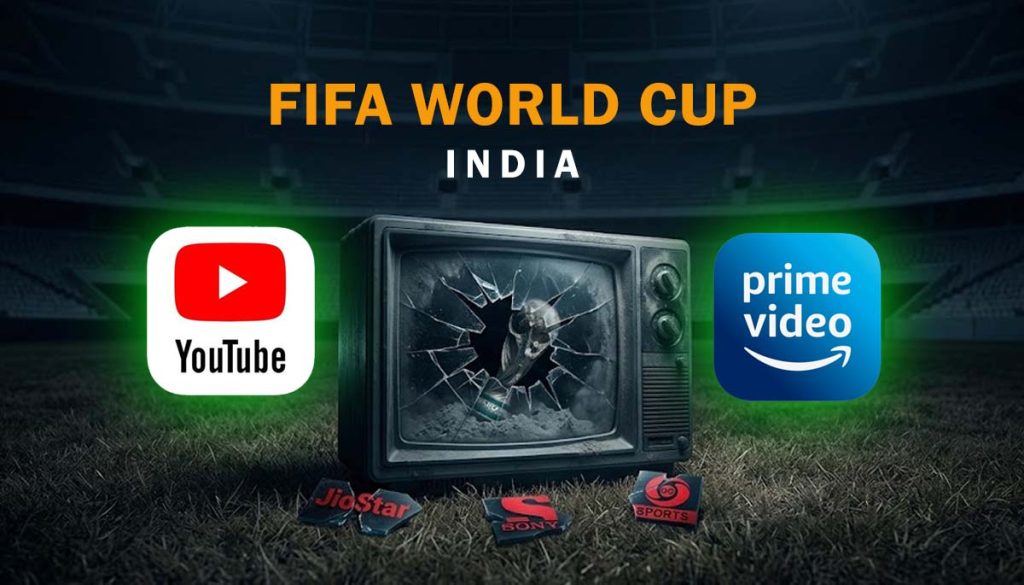

FIFA world cup is the biggest ever sports tournament that people love to watch and broadcasters all over world invest heavy money just to acquire broadcasting rights. But the Indian broadcasters (Jio, Star, Sony, and Prasar Bharati) have a different story. Instead of showing interest, they all are running away from this deal. So why Indian media companies are scared to buy FIFA 2026 rights? Let me open the real facts for you in Lehman’s language.
The First Problem: The Clock is Killing the Business
You want to watch FIFA World Cup 2026? Great. But ask yourself: will you wake up at midnight?
According to a report published on sports.yahoo.com, only 14-15 matches out of 104 are in the friendly slots (before 12:30 AM and after 6:30 AM). The rest of matches will be aired from mid-night to early morning. Even the most important matches like Semi Final 1, Semi Final 2 and The Final match will start at 12:30 AM IST.
Compare this to 2018 FIFA World Cup where 98.4% of matches ended before you brushed your teeth. In Qatar 2022, it was 82.5% good timing. But Now? Only 14 matches. Broadcasters know that if so if nobody is there to watch, to whom the companies will show ads? How they will make money? How they will make profit? This is the main reason the companies are not interested because a loss on investment is 100% certain.
The Second Problem: FIFA Wants Crores, But Gets Lakhs of Value.
Now talk about money. As shared on reuters.com, FIFA first demanded around $100 Million, later they reduced it to $35 Million. But still no broadcaster showed any interest in acquiring the media rights. As per aljazeera.com, the Reliance-Disney joint venture called JioStar offered only $20 million. But FIFA refused this offer.
Sony also knows that it would be a lose making deal, hence they did not bid to air this tournament in India. Even the insiders confirmed that Sony had $10 million, but when they heard FIFA demanded 10 times they pulled back their hands and now waiting for final minutes deal.
Even the latest report of NDTV Sports confirms that Prasar Bharati also backed out of this deal. India’s national public broadcaster distanced itself from the direct acquisition of broadcast rights for the upcoming FIFA World Cup 2026, stating that such responsibilities do not fall under its primary mandate.
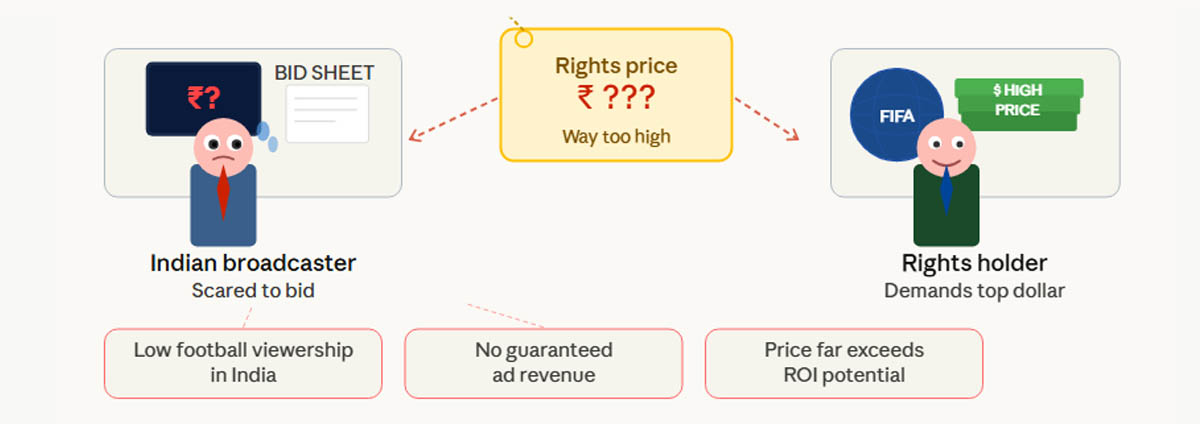
JioStar is not ready to pay more than $20 million, and the reason is 2022 FIFA Qatar World Cup. That time, Jio acquired the broadcasting rights in around $60 million, and lost around $24-30 million. In 2022, Jio was able to recover only half of its investment—and that too, when the timing was absolutely perfect for Indians. This time, the timings are brutal and broadcasters are not fools.
The Third Problem: No Breaks, No Money.
Here is a ground reality that no one talks about. A user shared an inside story on facebook.com that is 100% correct. Cricket has natural breaks. Over finished? Ad. Wicket falls? Ad. Drinks break? Long ad. But in the game of football? The ball keeps moving for 45 minutes straight. Where will you put the advertisement? Broadcasters cannot sell what they don’t have.
Even though there is a 15-minute half-time break, viewers tend to step away from their screens during that time to rest or take a short stroll. Therefore, if an advertisement is aired during those 15 minutes, no one will watch it. And if no one watches it, what will the broadcaster earn?
The Fourth Problem: Low Budget or No Budget
In India, many advertisers have burnt their money already on IPL. As we know, IPL is played during April and May each year. So after spending heavy money on cricket rights like IPL, the Indian ad market is now cautious. The advertisers pay a handsome price to show a 10-30 second on prime slots like 9:30 PM IST, but as many of the FIFA matches are scheduled to air in mid-night in India, no advertiser will take such a big risk.
Look there are 3 points here.
- Advertisers no longer have a budget because they have already invested it in the IPL.
- Even for those who do have the funds, their ads will never air during prime time.
- If you target low-budget brands—those with limited advertising budgets—you won’t generate any profit.
In short, from any perspective this will be a loss making deal. Hence the broadcasters are scared to acquire the FIFA 26 broadcasting rights in India.
The Final Whistle
So what is the final truth? Broadcasters are not anti-football. They are pro-survival. Bad match timings (only 14-15 good matches), high FIFA demands (from $100M to $35M, still too high), and low ad revenue because of no breaks – these three problems are a knockout punch.
Unless FIFA drops the price to $15-20 million and someone like JioStar or Sony takes a risk, the 2026 World Cup might be the first tournament that India watches on their phone via free streams, not on TV. And that, my friends, is the real loss. Not for broadcasters. For you, the real football fan.